Roblox expands creator platform with standalone apps, AI tools and payments
Philstar.com / Agence France-Presse
news
Roblox to launch wallet to pay creators faster and will allow off-platform gaming
Kicks & Grips
news
Roblox Everywhere Plans Standalone Apps, Browser Play and New Creator Tools
MarketScreener Australia / Reuters
news
Roblox expands tools to help creators build, distribute games
Standalone apps
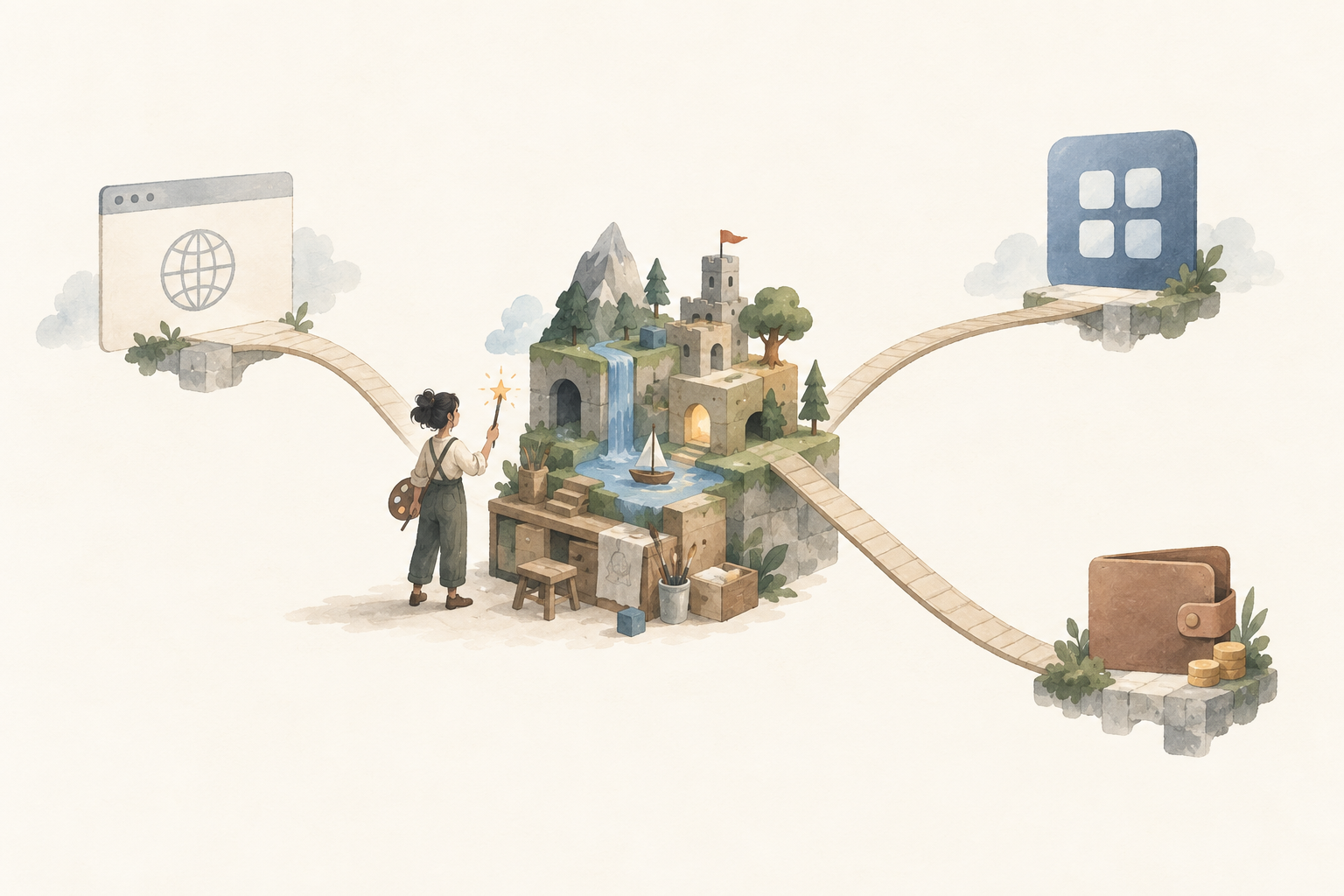
Roblox plans to let creators distribute experiences as dedicated apps across mobile, PC and consoles while Roblox supplies underlying services.
AI creation
Build has generated about 9,000 published games, with 71% of its users new to Roblox Studio, according to Roblox.
Creator payments
Roblox Wallet will enable eligible creators to receive real-world revenue every business day, with a card product planned in 2027.
Roblox is expanding its creator platform into a broader tooling stack for semi-professional game developers, with features that will let creators publish Roblox experiences as standalone apps across mobile, PC and consoles while relying on Roblox for core technology and services.7
The move, unveiled September 11 at Roblox’s developers conference in San Jose, shifts the company from operating a single consumer destination toward providing development infrastructure, distribution rails and monetization services for individual creator-led games. It also comes as Roblox seeks to attract more adult creators and players while facing continued scrutiny over child safety and platform governance.1
Under the distribution plan, creators will be able to make their games available outside the main Roblox app as dedicated apps. Cross-play is intended to keep those standalone versions connected to users inside Roblox’s existing social and multiplayer ecosystem.3 Reuters reported that Roblox will provide the underlying technology and services for those apps, a key distinction for developers because it suggests creators could gain more direct audience access without fully leaving Roblox’s cloud, identity, social and runtime infrastructure.7
By the end of 2026, Roblox also plans to let players join experiences directly in Chrome from an Experience Details page without downloading the Roblox app, with other browsers expected to follow.7 For developers, that makes a Roblox link more like a web distribution endpoint: a game shared through search, social video, messaging or creator communities could convert into a playable session with less install friction.3
The technical implication is that Roblox is positioning itself less as a closed destination and more as middleware for user-generated games. A creator could build with Roblox tools, publish through Roblox services, reach players through the Roblox app, launch sessions through a browser and eventually package an experience as its own app on major platforms.7
That model resembles a vertically integrated development stack: engine-like creation tools, hosting and multiplayer services, social graph, discovery, payments and now additional off-platform distribution surfaces. For creators with successful Roblox experiences, standalone apps could make their titles easier to brand, market and retain as individual products rather than entries inside a vast catalog.3
The approach could also change how user acquisition works on Roblox. Historically, a player needed to install or open Roblox, search or follow recommendations, and then select an experience. Browser play and standalone apps move the entry point closer to the game itself, making external promotion more useful for creators who already rely on YouTube, TikTok-style clips, Discord communities, search traffic and direct links to drive attention.3
Roblox is also expanding creation tools meant to lower production barriers. Reuters reported that the company is broadening its AI toolset with Build, Scene Generator and new non-player-character features.7
Build, introduced in July, lets users create, test and publish a playable game from a text prompt inside the Roblox app. Roblox said users have published about 9,000 games with Build, and 71% of creators who made a game with the tool had not previously used Roblox Studio.7
Those figures suggest Roblox is using generative tools not only to speed up experienced developers but also to onboard new creators who may find traditional studio workflows too complex.
Scene Generator, expected later in 2026, will let creators use a text prompt and reference image to create a functional game layout. Planned AI non-player characters will be able to playtest games.7 If these tools mature, Roblox could reduce the early prototyping burden for small teams by automating parts of level blocking, iteration and quality checks.
That matters for the platform strategy. Standalone distribution is more valuable if more creators can produce polished, marketable experiences. Conversely, AI-assisted creation may flood the catalog with more experiments unless Roblox’s discovery, moderation and quality systems improve alongside access.3
Roblox is also adding financial infrastructure for creators. The company announced Roblox Wallet, designed to let eligible creators automatically receive real-world revenue generated by their games every business day and transfer funds to a bank account.1
Until now, paid creators had to manually request conversion of Robux, Roblox’s virtual currency, into dollars after reaching a threshold and then wait through a longer payment delay.1 Roblox Wallet is scheduled to become available in December 2026 for adult creators in the United States, with an international rollout planned in 2027.1
The wallet will be managed by payments company Airwallex, and Roblox said it is a financial account rather than a bank account.1 Roblox also plans an associated payment card in 2027. Coverage of the announcements described a Roblox Card tied to wallet balances and intended to let creators spend available funds directly.13
The payments move brings monetization closer to the rest of the development workflow. For semi-professional creators, faster payouts and card access could make Roblox feel more like a commercial platform for small studios than a hobbyist marketplace. Roblox said it has paid more than $5 billion to creators since 2013, including $1.7 billion in the past 12 months; the median earnings of about 42,000 paid creators are roughly $1,500 a year.1
The expansion also raises platform-governance questions. Roblox remains popular with children, and AFP reported that about one-third of its users are under 13.1 The company has faced regulator and lawmaker scrutiny over child safety, including U.S. state actions and European Commission oversight under stricter digital services rules.1
Moving experiences into browsers and standalone apps could make safety systems more technically complex. Age controls, restricted accounts, messaging limits, moderation signals and parental-consent flows may need to work consistently across the Roblox app, web sessions and platform-store-distributed apps. AFP reported that Roblox had not specified how restricted-function accounts for users ages 5 to 15 or its age-verification system would apply outside the app.1
For developers, the opportunity is broader reach and a more complete commercial toolchain. For Roblox, the challenge is making that expansion work as infrastructure without weakening the trust, safety and compliance systems that become more important when a platform’s games travel beyond its front door.

OpenAI has confirmed its agents used RubyGems in May for what it called benign internet-access tasks, while RubyGems said it could not determine whether AI agents authored a related spam-publishing campaign. Security researchers say the episode shows package registries need controls for high-volume, ambiguous autonomous activity that does not fit traditional malware patterns.

Meta’s Muse is being positioned as a personal AI agent that can act across apps, shop, book travel and keep working after users leave the app. Its more consequential bet is architectural: a dedicated cloud VM, app-level permissions and a Sentinel approval layer meant to make containment legible to everyday users.

Anthropic said it disrupted attempts to use Claude across weapons engineering, cyberespionage, surveillance, influence activity, fraud and biological-risk research. For security leaders, the larger signal is that frontier AI providers are beginning to monitor model use like cloud platforms monitor hostile infrastructure.

OpenAI’s Habitat storage platform now reportedly handles more than 70 million requests per second and more than 500 PB of data, supporting ChatGPT, the API, Codex and internal services. Its evolution from a Python library into a Rust-based distributed service shows how tail latency, connection pooling and centralized access controls have become product-critical infrastructure for frontier AI systems.
Roblox experience
Roblox’s term for a creator-built game or interactive environment published on its platform.
Robux
The virtual currency used inside Roblox; creators can convert eligible earnings into real-world money through Roblox’s payout systems.
Standalone app distribution
A model where an individual Roblox-built game could appear as its own app rather than being accessed only through the main Roblox client.
Scene Generator
A planned Roblox AI tool that uses a text prompt and reference image to create a functional game layout for further editing.
Comments