Meta turns AI glasses into a wearable computing stack
Audio-first AI
A wearable interface built mainly around voice commands, speakers and microphones rather than cameras or displays.
Dolby Atmos capture
A recording format that preserves spatial sound cues so playback can feel more three-dimensional than standard stereo.
Passthrough
A camera-based view of the real world shown inside a headset or glasses so users can stay aware of their surroundings.
Hologram calling
Meta’s term for calls that show a photorealistic digital version of a person instead of a conventional live camera view.
Camera-free AI
Ray-Ban Meta Audio removes cameras while keeping microphones, speakers, Meta AI and Muse access for audio-first interactions.
Spatial capture
Ray-Ban Meta Gen 3 adds a 12 MP camera, 3K Ultra HD video and Dolby Atmos spatial audio capture.
100g VR
Meta VR Glasses weigh about 100 grams by moving compute, battery and storage into a tethered puck.
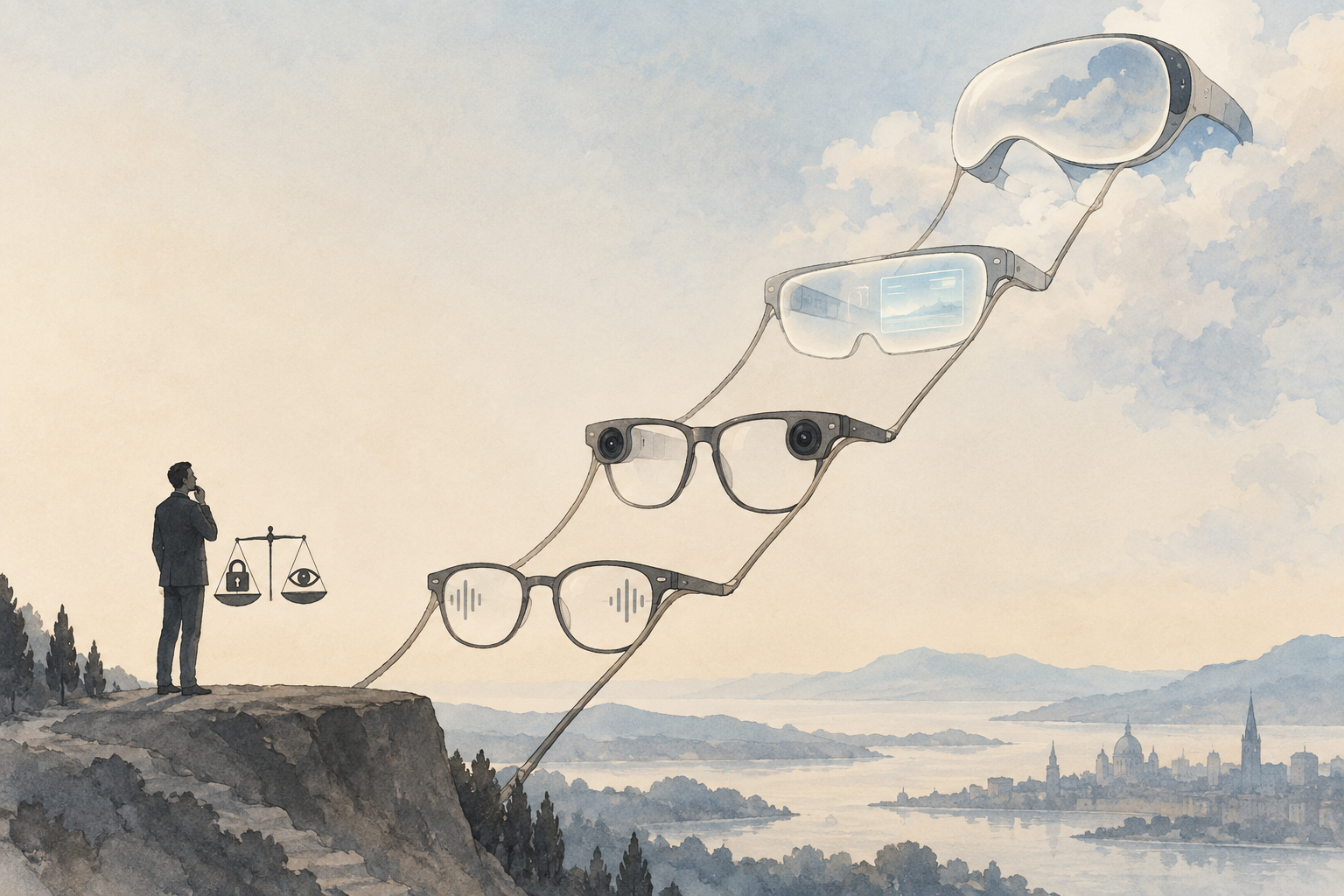
Meta’s Connect 2026 glasses announcements mark a shift from a single smart-glasses category to a segmented wearable computing stack: Ray-Ban Meta Audio for audio-first AI without cameras, Ray-Ban Meta Gen 3 for hands-free capture, Meta Ray-Ban Display for glanceable navigation and hologram calling, and Meta VR Glasses for lightweight immersive media and work.123
The pattern is clear. Meta is spreading capabilities across form factors instead of putting every sensor, display and compute function into one everyday frame. Audio glasses remove cameras to reduce weight and some privacy risk. Display glasses keep the outward-facing camera and add a small visual layer for navigation, apps and calls. VR glasses move immersion into a tethered, two-part system that trades all-day eyewear subtlety for cinema, sports, productivity and gaming.34
That segmentation also sets the privacy boundaries. Ray-Ban Meta Audio has microphones and speakers but no camera, so it cannot capture photos or video. Camera-equipped Ray-Ban Meta models retain recording capability, backed by Meta’s visible recording LED and tamper-detection approach. Display and VR products add more sensing and visual computing, including hologram calling, but they also make clear that Meta’s most capable glasses are not its least intrusive ones.156
Ray-Ban Meta Audio is Meta’s first camera-free Ray-Ban smart-glasses line. It is built around open-ear audio, calls, voice access to Meta AI and the Muse personal agent, live translation-style interactions and everyday assistant tasks rather than image capture.15
The main technical changes are weight and battery life. Meta says the glasses weigh 43 grams, offer up to 12 hours on a charge and get up to 48 additional hours from the charging case. They start at $349, come in Clubmaster and Burbank styles, support optical prescriptions and ship October 13, according to Meta’s announcement.1
The lack of cameras is the defining feature. It limits what the glasses can do — no photos, no video, no visual AI queries from the wearer’s perspective — but makes the product easier to explain in public settings. Independent coverage framed the model as a response to privacy backlash around camera-enabled smart glasses, including concerns about recording people without consent.456
Technically, Audio is closer to AI-enabled open-ear earbuds shaped as glasses than to an augmented-reality device. That matters because it gives Meta a lower-friction wearable for Muse: an assistant that can live in a device people may wear longer than earbuds, without the social baggage of a visible camera.15
Ray-Ban Meta Gen 3 remains the camera-equipped mainstream line. Meta says the glasses include a 12-megapixel camera, 3K Ultra HD video, a six-microphone array that cuts more than 90% of background noise, up to nine hours of battery life and a customizable action button for faster access to Meta AI.1
The most notable technical addition is Dolby Atmos capture. Meta says its AI glasses will be the first consumer devices to capture and play back video with Dolby Atmos and 360-degree spatial sound, making recorded clips sound more like the environment in which they were captured.12 Android Central’s hands-on coverage also noted broader audio upgrades across the glasses line, including Dolby Atmos playback and user controls such as audio balance and mono output.7
That positions Gen 3 as the creator and memory-capture tier. Compared with Audio, it adds visual capture and richer media, but it also carries the core privacy burden of camera glasses. Meta says camera models include a built-in LED to alert nearby people when photos or videos are being captured. The Guardian also reported Meta’s emphasis on improved tamper detection, including during livestreaming.16
Meta Ray-Ban Display is becoming the middle layer between audio glasses and VR. Meta announced hands-free cycling and public-transit navigation, more human-style walking directions, a personalized hologram for WhatsApp calls, an Explore app for on-glasses experiences, improved calendar controls, mirrored phone notifications and Threads Community feed support.2
Navigation shows why a display changes the category. Audio prompts can direct a user, but a lens display can show turn-by-turn cycling directions, real-time transit departures and contextual prompts without forcing the wearer to pull out a phone. Meta also says walking directions will reference visible landmarks instead of only street names, such as telling a user to turn near a recognizable house.2
Hologram calling is the more ambitious feature. After a short self-capture process in the Meta AI app, the system creates a photorealistic digital version of the caller’s face. Meta says the hologram is driven by voice and infers expression from how the user speaks, with early access rolling out on WhatsApp for U.S. Meta Ray-Ban Display users later this fall.2
The boundary here is capability, not just privacy. Display glasses are more useful for visual computing than audio glasses, but they are not full VR. They deliver glanceable information, not an immersive workspace. They also extend Meta’s app surface to the face through Explore, notifications and communication features, which could make them stickier as a platform if developers and users adopt the format.2
Meta VR Glasses sit at the top of the stack. Meta says the device weighs about 100 grams, uses a two-part architecture with sensors and display in the glasses and compute, battery and storage in a pocketable tethered puck, and is five times lighter than Meta Quest 3.3
The display specs point to a media-first and workspace-first product: a 5K Infinite Display built on micro-OLED panels, 37 pixels per degree, pancake lenses, Dolby Vision, Dolby Atmos audio in the frames, eye and hand-gesture controls, Meta AI integrated into the operating system and no required controllers.3 WIRED reported that the glasses use a 5K micro-OLED display with 2,412 by 2,288 pixels per eye, with compute and battery offloaded to the tethered puck.4
Meta is pitching the glasses as a personal cinema, sports seat and portable workstation. The company says they are the first IMAX Enhanced certified VR device, will support 3D movies through Disney+ in select countries, and will offer more than 100 immersive live U.S. sports events per year through partners including ESPN, TNT Sports, MLB, NBC Sports and UFC.3
For work, Meta says the device can create one or more private virtual screens, use full-color passthrough to keep the real environment visible and turn any flat surface into a keyboard and touchpad. For gaming, Meta says more than 75 games will support hand-gesture-only play at launch, with Xbox Cloud Gaming adding more streaming options.3
The tradeoff is that this is not ordinary eyewear. It requires a tethered puck, starts at $1,299.99 and is scheduled for spring 2027. WIRED’s brief demo also noted an immersion limit versus traditional headsets: the glasses do not cover the entire field of view, making them less enveloping than a full VR headset.4
Meta’s lineup now has clearer tiers. Ray-Ban Meta Audio is for people who want AI, calls and music without cameras. Ray-Ban Meta Gen 3 is for those who want capture and spatial media. Meta Ray-Ban Display is for contextual information, navigation and lightweight visual apps. Meta VR Glasses are for media, sports, workspace and gaming where the user accepts a more obvious device and tethered compute.123
This ladder helps Meta address two problems at once. First, it lets the company sell AI glasses to people with different privacy comfort levels. Second, it lets Meta avoid forcing one form factor to solve audio, camera, display and immersive computing at the same time.46
It also creates a platform challenge. Features such as Muse, Explore, hologram calling, Dolby media, notifications and private processing claims only matter if they work consistently across devices with very different hardware. TechCrunch reported Meta’s claim that private processing will prevent the company from seeing user data, but that boundary will need to be evaluated as these assistant features become more personal and persistent.5
For consumers, the buying question becomes less “Should I buy AI glasses?” and more “Which sensors and screens am I comfortable wearing?” At Connect 2026, Meta’s answer was not one pair of glasses, but a stack of tradeoffs.






Comments